COTABATO CITY—Bangsamoro Autonomous Region in Muslim Mindanao (BARMM) posted the largest decline in family poverty incidence among the country’s 18 regions, with the rate falling from 26 percent in 2023 to 12.8 percent in 2025, according to data released on Aug. 26, 2026 by the Philippine Statistics Authority (PSA).
The 13.2-percentage-point drop was nearly three times the nationwide decline of 4.5 percentage points, as the national family poverty incidence decreased from 10.9 percent to 6.4 percent over the same period.
The latest figures moved BARMM from having the country’s second-highest family poverty incidence in 2023 to sharing the fourth-highest rate in 2025 with Eastern Visayas, both at 12.8 percent.
All BARMM provinces and Cotabato City registered lower family poverty incidence in 2025.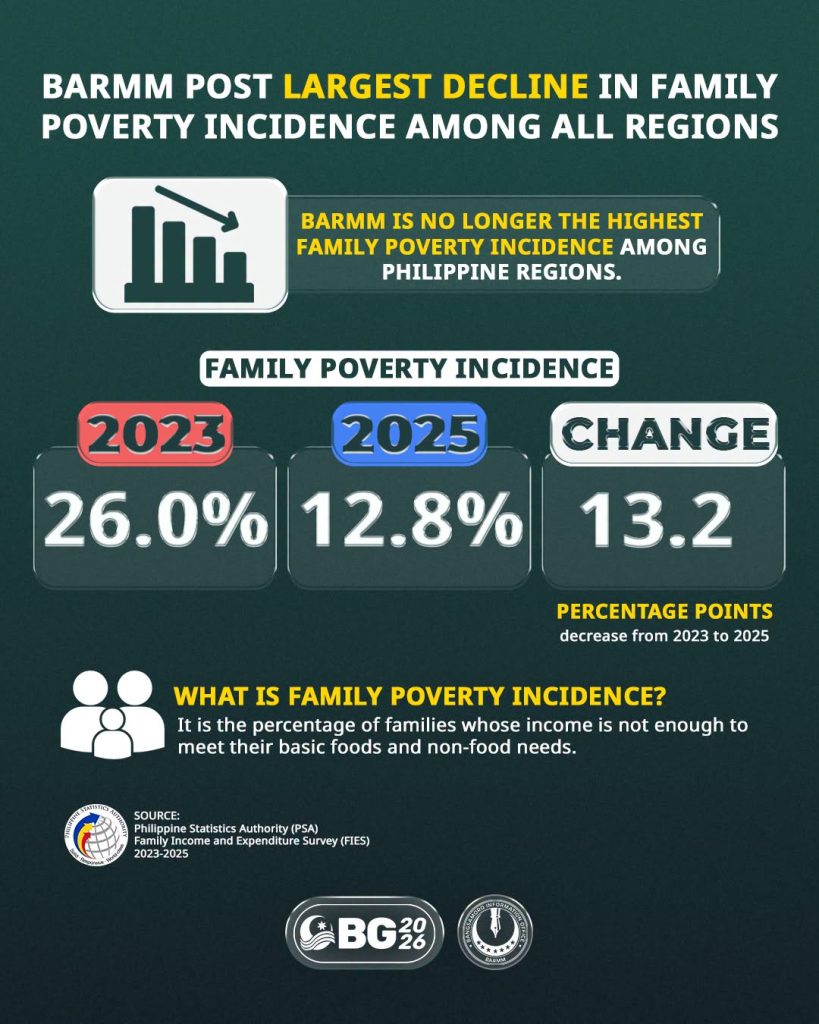
Basilan posted one of the sharpest improvements, with its poverty incidence dropping from 33.7 percent in 2023 to 10.4 percent in 2025. Tawi-Tawi’s rate also declined significantly, from 32.3 percent to 11.6 percent.
Lanao del Sur recorded a decrease from 12.1 percent to 3.2 percent, while Maguindanao del Norte’s poverty incidence fell from 28.4 percent to 19 percent.
Maguindanao del Sur saw its rate decline from 32.1 percent to 17.8 percent, while Cotabato City recorded a drop from 33.3 percent to 16.7 percent.
The PSA noted that no province in the country recorded a family poverty incidence above 30 percent in 2025. The highest provincial range was 20 percent to below 30 percent, a marked improvement from 40 percent to below 50 percent in 2021 and 30 percent to below 40 percent in 2023.
Despite the gains in poverty reduction, BARMM continued to register the lowest average annual family income among all regions at P246,050 in 2025, compared with the national average of P411,350.
The region was also the only one where entrepreneurial activities served as the primary source of family income, accounting for 43.8 percent of total family income. In all other regions, wages and salaries remained the main source of earnings.
Average annual family expenditure in BARMM reached P202,170 in 2025, likewise the lowest among regions and below the national average of P321,850.
At the provincial level, Maguindanao del Sur recorded the country’s lowest average annual family income at P177,750.
The Bangsamoro Planning and Development Authority (BPDA) said the latest figures provide valuable insights for policymakers and development planners.
“The results provide an updated picture of the poverty situation across BARMM and will help inform regional and local development planning, policy formulation, and the continued monitoring of poverty reduction efforts in the region,” the BPDA said.
The Ministry of Finance, and Budget and Management (MFBM) likewise highlighted the role of evidence-based fiscal planning and budgeting in directing resources toward programs and investments that improve socioeconomic conditions.
In an official Facebook post on Aug. 28, MFBM said, “sustaining this momentum will be key to further reducing poverty and ensuring that the gains of development reach more families.”
The PSA’s poverty estimates were derived from income data collected through the 2025 Family Income and Expenditure Survey (FIES) and measured against the corresponding poverty thresholds for each region.
The 2025 FIES gathered income and expenditure data for the periods January to June and July to December 2025 through survey rounds conducted in July 2025 and January 2026. (Norhaifa Dipatuan/BIO)