
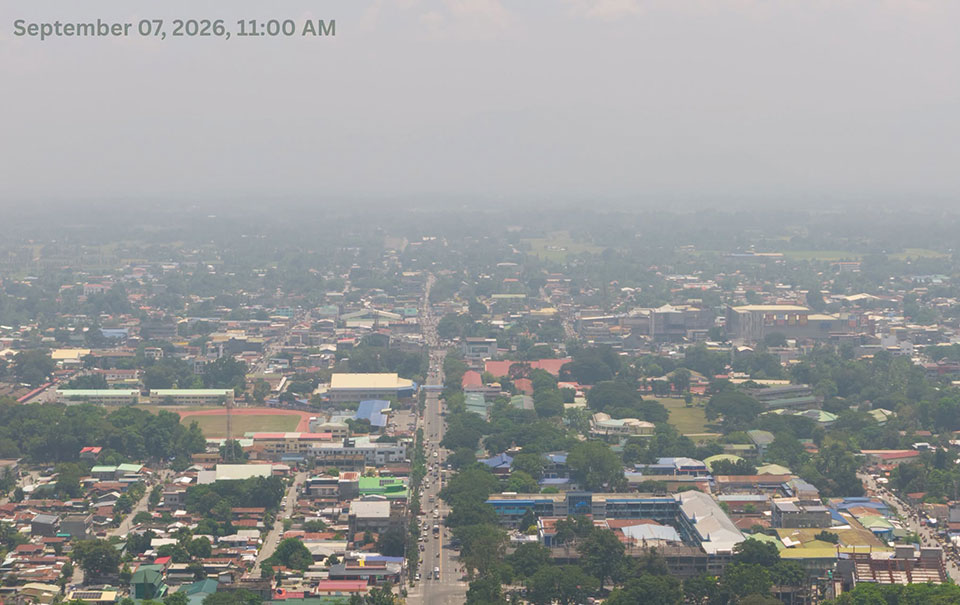
The Department of Environment and Natural Resources–Environmental Management Bureau (DENR-EMB) Region XII continues to monitor air quality conditions following elevated levels of PM2.5 (Particulate Matter with a diameter of 2.5 micrometers or smaller) recorded at the Koronadal Air Quality Monitoring Station.
The Koronadal CAAMS-PMS Station at the City Hall Compound recorded elevated 24-hour average PM2.5 concentrations in recent days. The highest 24-hour average recorded was 48 µg/m³ on September 1, 2026, while the latest reading on September 6 was 44 µg/m³. These values exceeded the 35 µg/m³ maximum limit for a 24-hour average under DAO 2020-14.
PM2.5 and Transboundary Haze
PM2.5, or fine particulate matter with a diameter of 2.5 micrometers or smaller, is one of the important components of smoke generated by fires. Because of its very small size, PM2.5 can remain suspended in the atmosphere and may be transported over long distances by prevailing winds.
The elevated particulate matter observed in the region may be associated with transboundary haze from fires in Kalimantan, Indonesia, which may be transported toward affected areas by prevailing winds. However, the available monitoring results alone cannot establish the exact source of the PM2.5 measured at the Koronadal Station.
Limited PM2.5 Monitoring in Region XII
DENR-EMB XII emphasizes that only the Koronadal Air Quality Monitoring Station currently has the capability to analyze PM2.5.
Meanwhile, the monitoring facilities in Tupi, South Cotabato, and General Santos City use Portable Ambient Air Quality Monitoring Equipment, which can measure PM10 (Particulate Matter with a diameter of 10 micrometers or smaller) but cannot analyze PM2.5.
The other areas of Region XII currently have no established ambient air quality monitoring stations. Therefore, there are no station-based PM2.5 measurements available to characterize air quality in these areas.
PUBLIC IS ADVISED TO TAKE PRECAUTIONARY MEASURES
In view of the prevailing haze and elevated particulate matter levels, DENR-EMB XII urges the public to take precautionary measures, particularly in areas where haze is visibly noticeable.
The public is advised to:
1. Reduce unnecessary and prolonged outdoor activities, particularly in areas visibly affected by haze;
2. Minimize unnecessary outdoor activities from 5:00 PM to 7:00 PM, when outdoor human activity is commonly higher, to reduce unnecessary exposure to air pollutants;
3. If going outdoors is necessary, wear a properly fitted face mask, preferably an N95 or equivalent, especially in areas with noticeable haze;
4. Limit exposure to outdoor air pollution, particularly among children, older persons, and individuals who may be more vulnerable to its effects;
5. Keep doors and windows closed when possible to minimize the entry of outdoor pollutants;
6. Refrain from open burning of garbage, leaves, and other materials, as smoke from open burning adds particulate matter and other pollutants to the air and may further worsen local air quality; and
7. Stay informed by following official air quality advisories and updates from DENR-EMB XII and local authorities.
DENR-EMB XII reminds the public that protecting and maintaining good air quality is a shared responsibility. While the current haze may be influenced by sources beyond our borders, everyone can help minimize its impact and prevent further deterioration of local air quality. The public is therefore encouraged to reduce unnecessary exposure to outdoor air pollution and, most importantly, refrain from activities that generate smoke, particularly the open burning of garbage, leaves, and other materials.
DENR-EMB XII will continue to monitor available air quality data and provide updates and advisories as necessary. The public is encouraged to remain vigilant and follow official advisories from DENR-EMB XII and local authorities.